
How to Build a Cheap Low-Stress-Training Screen and Bend Your Plants Into Bigger Yields
A ScrOG screen costs almost nothing and turns one ragged Christmas-tree plant into a dozen even, light-fed colas. Here is how to build one, run it through the stretch, and avoid the mistakes that cost yield.
Left alone, a cannabis plant grows like a Christmas tree. One fat cola spears up top, hogs the light, and a sad crowd of larfy little buds sits underneath in its shadow getting nothing. That is your tent space wasted and your electricity bill paying to grow popcorn. A screen fixes it. You flatten that tree into a wide, even table where every bud site sits at the same height under the light, and the plant that used to make one good cola now makes a dozen.
Growers who track it consistently report yield gains in the 20 to 40 percent range over an untrained plant of the same genetics, purely from getting more bud sites into the high-intensity zone under the light. It is the cheapest meaningful upgrade most home growers will ever make. No new lights, no bigger tent, no exotic nutrients. A bit of netting, some soft ties, and a habit of tucking growth every couple of days. Build the whole thing for the price of a coffee and run it on a plant you already own. Here is how it works, how to build it, and how to run it without choking your own yield.
Why a screen actually works
There is real plant physiology under this, not folklore. Cannabis produces a hormone called auxin that concentrates at the highest growing tip and travels downward, suppressing the side branches below it. That is apical dominance: the apex tells the rest of the plant to stay small so it can keep climbing toward the light. It is why an untrained plant pours everything into one terminal cola and leaves the lower sites underdeveloped. Auxin from the top is actively inhibiting the lateral buds beneath it (apical dominance explained).
When you bend that top tip sideways and pin it level with the rest of the canopy, you break the hierarchy without cutting anything. The hormonal signal redistributes, the lower branches stop being suppressed, and they surge upward to compete. Now instead of one dominant tip you have a whole field of them, all sitting at the same height, all getting the front-row light the single cola used to hog.
The technique is called ScrOG, short for Screen of Green. The "low-stress" part matters: you are bending and weaving, never wounding. A topped plant has to seal a cut and recover before it bounces back. A bent plant keeps growing through the whole process, which is why a screen tends to be gentler on the plant and more forgiving for a first-timer than aggressive defoliation or topping alone.
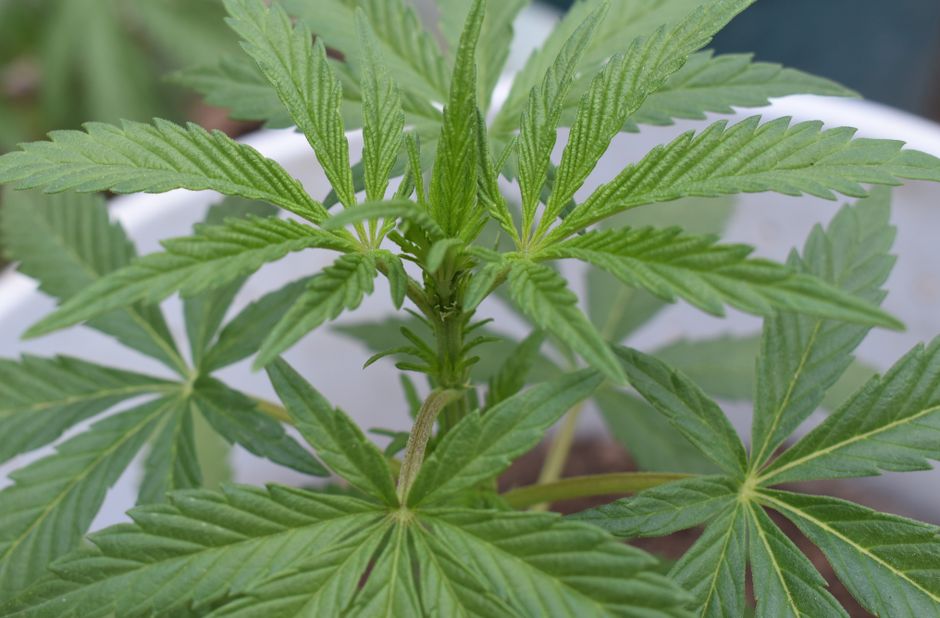 A filled screen turns one plant into a flat table of evenly lit colas.
What you need (and what you do not)
This is the part people overcomplicate. You do not need a branded trellis kit. You need a flat grid held at a fixed height above the pot.
- A frame. PVC pipe with four corner elbows is the classic, but a spare picture frame works, and so do four eye-hooks screwed into the rim of a fabric pot with twine strung across. Anything that holds a grid rigid and level.
- The grid itself. Trellis netting, plastic garden netting, or plain garden twine tied into squares. Roughly 5cm by 5cm spacing is the sweet spot: small enough to support buds, big enough to reach a hand through and tuck.
- Soft plant ties or velcro strips. For the occasional stubborn branch that needs persuading rather than weaving.
- A hygrometer and a small clip fan, if you do not already run them, ideally moving air at a distance of 30 to 60cm below the canopy. A flat dense canopy traps humidity, and you will want airflow underneath it.
That is the entire bill of materials. Total cost is a few dollars. Resist the urge to overbuild; a screen is a tool, not a project.
A quick word on screen choice, since people ask. A fixed screen sits at one height and the plant grows up into it. A scrog over a single fixed net is the standard for one tent, 1 or 2 plants. There are two-layer setups and adjustable rigs, but for a home grower a single rigid net at the right height does everything you need. Keep it simple.
Step by step
1. Set the screen height. Mount the net about 20 to 30cm above the top of your pot, using roughly 15cm as the floor for a short, bushy strain and 30cm for a stretchier one. You want headroom for the plant to grow up into the screen during veg before you start tucking. Too low and you have nothing to work with; too high and the lower canopy stays shaded longer than it should.
2. Build a plant worth screening. A single-stem plant fills a net poorly because it only has so many tips. Topping once or twice during veg, or using a well-branched strain, gives you the multiple growing points that make a screen pay off. If you are new to shaping plants, the same logic that helps here is covered in the broader rundown of things first-time growers get wrong — single-cola plants are near the top of that list.
3. Let the plant reach the net, then start tucking. Grow normally until the tallest tips poke through the screen. When a tip clears the net by 5 to 10cm, gently bend it sideways and tuck it under the next empty square over. Always weave horizontally, filling gaps. Do this every couple of days; most tucked branches visibly reorient toward the light within 24 to 48 hours, which is your cue for the next round. The target is an even green carpet with no tall spikes breaking the surface.
4. Tuck hardest through the stretch. When you flip to 12/12, the plant stretches fast in the first 2 to 3 weeks of flower. This is the window where a screen earns its keep. Keep tucking aggressively, filling every square, spreading the canopy wide and flat. Most growers under-tuck here and end up with an uneven table. Once the squares are full and buds are setting, stop tucking and let the colas grow up through the net.
5. Lollipop everything underneath. Once the screen is full, the entire zone below it lives in permanent shade. Strip those lower leaves and weak shoots. Lollipopping stops the plant from wasting energy on popcorn buds it cannot light properly and pushes that energy up into the fat colas sitting in the canopy. Do this around the same time you stop tucking, not before.
6. Support the weight late in flower. Big even colas get heavy. A screen doubles as a support structure, but check that branches are resting on the net rather than straining against a single tie. A leaning cola in week 7 is a cracked branch waiting to happen.
A simple timeline to keep you on track
It helps to see where each move lands in the grow. Adjust to your own strain and conditions, but this is the rhythm.
| Stage | What you are doing | Roughly when |
|---|---|---|
| Early veg | Top once or twice, build branching | Weeks 1-3 of veg |
| Late veg | Plant grows up into the screen | Until tips clear the net |
| Stretch | Tuck hard, fill every square | Weeks 1-3 of flower |
| Mid flower | Stop tucking, lollipop the understory | Around week 3 |
| Late flower | Support heavy colas, watch airflow | Weeks 6 to harvest |
The rules that keep it working
- Bend with the plant, never against it. If a branch is too stiff to move, work it earlier in the day when stems are most flexible, or split a long bend across two sessions. A clean bend is free yield. A cracked stem is a setback you taped up out of guilt.
- Stop training once flowering is established. After the stretch, the net should be full and your job is mostly done. Keep manhandling bud sites that should be fattening and you trade size for stress.
- Match plant count to screen size. One or two well-trained plants will fill a small screen completely. You do not need a jungle, and crowding the net just chokes airflow.
- Keep air moving under the canopy. A flat, dense table is a humidity trap, and tight buds packed against a net are exactly where bud rot starts. Once relative humidity under a packed canopy climbs past 60 to 65 percent, mold risk goes up fast, so a small fan moving air across and below the screen is cheap insurance.
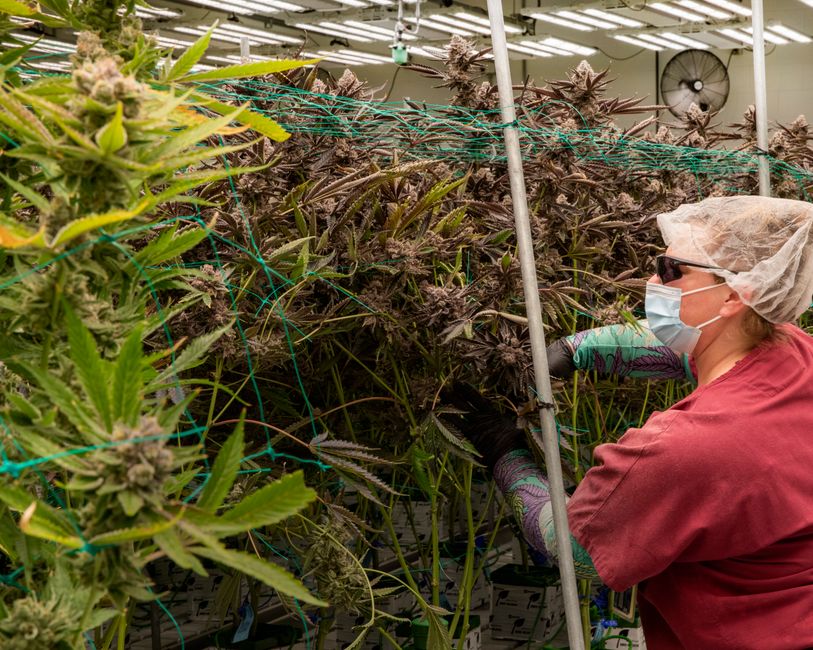 Weave new growth into empty squares every couple of days through the stretch.
Where a screen fits with everything else
A screen is one lever, not the whole machine. Even a good LED loses a lot of its punch by the time it travels the 30 to 45cm from a typical fixture down to a flat canopy, so putting more bud sites inside that close, high-intensity band is one of the highest-leverage things you can do indoors. But it does not fix weak genetics, sloppy feeding, or a rushed harvest. If you are chasing bigger yields, the honest truth is that technique beats hardware most of the time — a point worth sitting with if you have ever been tempted to think more watts make you a better grower.
It also pairs naturally with the rest of the grow cycle. Found a plant that screens beautifully and finishes loud? That is a keeper, and the next move is to copy it exactly by taking and rooting clones, usually ready to pot up within 10 to 14 days, so you can run the same trained structure again. And whatever the screen helps you grow, you can still ruin it at the finish line, so give the dry and cure the same respect you gave the training.
Common questions
Does a screen actually increase yield, or just spread it out? Both, really. The mechanism is light distribution: a flat canopy puts far more bud sites in the high-intensity zone close to the lamp instead of stacking them at uneven heights where the lower ones get scraps. More productive sites at the right distance from the light is what drives the bigger number at harvest.
Can I ScrOG an autoflower? Carefully. Autos run on a fixed clock and do not wait for you, so heavy training or topping can cost them time they cannot recover. Stick to gentle tucking and skip the aggressive topping. Many growers prefer to train photoperiod plants for screens precisely because you control the veg length.
How many plants per screen? For a typical small tent, one or two well-branched plants will fill the net. A single topped plant given enough veg time can carry an entire screen on its own. More plants means more root competition and worse airflow, not more weed.
What if my branches snap when I bend them? You are probably bending too late in the day or too fast. Stems are most pliable in the morning. If one does crack, do not panic — tape it firmly with the broken faces together, support it, and the plant will often heal the joint into a thicker, stronger node. It is a setback, not a death sentence.
Do I keep tucking the whole flower cycle? No. Tuck hard through the stretch, then stop once the squares are full and buds are forming. After that the screen is just support. Training mature bud sites only stresses them.
A screen turns the plant's own rules in your favor. You are not fighting it — you are handing every bud site the seat the top cola wanted to keep for itself. Cheap to build, easy to run, and the difference on the scale at harvest is the kind you can see across the room.