
The Science of Trichome Density: Why Some Genetics Drip Resin and Others Don't
A grounded look at the biology behind trichome density, why it is mostly written into the genetics, and what a grower can actually do to maximize resin.
Two growers can run the same nutrients, the same light, the same tent, and pull two completely different plants. One finishes frosted to the stem, knuckles crusted in resin so thick the leaves stick together. The other looks clean and green with barely a sparkle. Same care, different result. The difference is mostly written into the seed.
Trichomes are where the value lives. They are the resin glands that hold the cannabinoids, the terpenes, the gas, all of it. Understanding why some genetics drip and others stay dry tells you what to chase when you buy seeds and what you can realistically push in the tent.
What a trichome actually is
The frost you see is made of capitate-stalked trichomes, tiny mushroom-shaped glands that rise off the flower and sugar leaves on clear stalks topped with a bulbous head. That head is a chemical factory. Inside it, the plant builds and stores cannabinoids like THCA and CBDA alongside the terpenes that give a strain its smell.
The plant did not evolve these to get you high. They are defense: a sticky, aromatic, UV-resistant coating that deters insects, traps them, and shields the developing seeds from radiation and fungus. The "loud" plants we prize are, biologically, the most heavily armored ones.
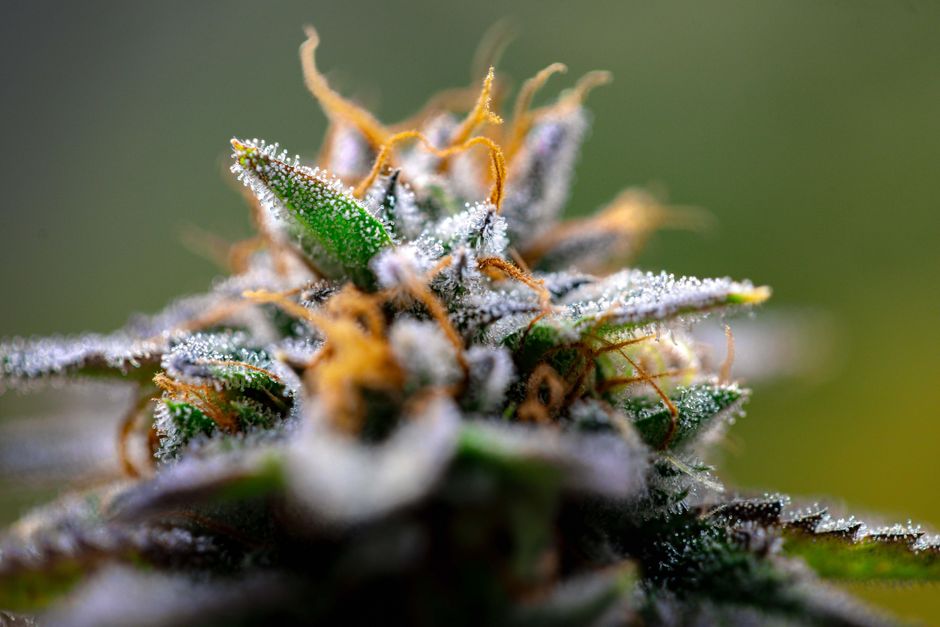 Every one of those crystals is a glandular factory building cannabinoids and terpenes. Photo: Pexels.
Genetics sets the ceiling
Here is the part most people skip. Trichome density is highly heritable. The number of gland sites a plant can produce, how big the heads swell, and how densely they pack onto the flower are traits coded into the genome before the seed ever cracks.
Some lineages are simply gland-dense. Resin-bomb cuts throw enormous, tightly spaced trichomes because generations of selection rewarded exactly that. Other lines, even potent ones, run sparser glands. No feeding schedule turns a genetically sparse plant into a resin bomb. Your environment can only push the plant toward its own ceiling, and genetics builds the ceiling. This is why we breed for frost as hard as we breed for smell. The ceiling is decided before the seed goes in the soil, and nothing you do afterwards raises it.
What the plant responds to
Genetics sets the ceiling, but a few real levers help the plant reach it.
- Light intensity and spectrum. Trichomes are partly a UV defense, so strong light, including a measured amount of UV, can encourage denser, more potent resin production. There is a limit, and bleaching your tops helps nobody, but adequate intensity matters.
- Cooler finishing temperatures. Dropping night temps in late flower, into the high teens Celsius, tends to preserve terpenes and can deepen resin and color expression.
- Lower humidity in late bloom. Drier air in the final weeks pushes the plant to protect itself and keeps mold off the dense, sticky flowers you are trying to grow.
- Not over-feeding nitrogen late. Heavy nitrogen into flower keeps the plant in vegetative mode and works against fat, finished glands. Let it fade.
Timing is its own science
Trichome heads change color as they mature, running from clear to cloudy to amber. That shift tracks the cannabinoids inside breaking down and changing character. Clear heads are immature, cloudy heads signal peak cannabinoid content, and amber heads mean THC is degrading toward more sedating CBN.
A jeweler's loupe or a cheap pocket microscope turns harvest from a guess into a decision. Most cuts hit their loudest, most complete profile somewhere in the mostly-cloudy window. Pull too early and you leave potency and aroma on the table. Pull too late and the gas fades into something duller.
 Clear, cloudy, amber — the heads tell you when the gas is at its peak. Read them, don't guess. Photo: Flickr (CC BY 2.0).
Worth saying plainly: trichome color is a ripeness signal, not a potency ranking. Cloudy isn't "stronger" than clear in some absolute sense — it's the window where this particular plant expresses its fullest profile. Different cuts also frost at different rates, so judge each plant against itself, not against a photo of someone else's.
What this means when you buy seeds
If you want frost, buy frost. A resin-heavy result starts with a lineage selected for gland density, not with a miracle additive. Read what a breeder actually selects for, look at honest photos under real light, and treat heavy reported resin as a genetic promise rather than a growing tip. This is exactly the kind of trait that hides in the family tree, which is why reading a strain's lineage pays off before you spend a cent.
Then do your job: strong light, a cool and dry finish, a clean fade, and a patient eye on the trichomes. Give great genetics a good environment and they will drip. Give weak genetics the best environment on earth and they will stay green.